
Uzbekistan Silk Road Itinerary: Samarkand, Bukhara & Khiva for Groups
Few itineraries sell themselves like Uzbekistan’s Silk Road. Samarkand, Bukhara and Khiva are three of the most photogenic historic cities anywhere, the country has opened up dramatically for visitors, and a fast modern train ties the route together. For tour operators it’s a rare combination: genuinely exotic for clients, yet straightforward to run. Here is the classic group itinerary, a longer version for operators who want depth, and the logistics behind both.
If your agency is new to Central Asia, it helps to understand the ground operation first. A destination management company contracts the hotels, trains, flights, transport, guides and meals locally, then hands you one coordinated programme. On the Silk Road that matters more than usual, because the route hinges on train seats and an internal flight that have to be booked weeks ahead and in the right sequence.
Entry: easier than clients expect
Uzbekistan has overhauled its visa policy. Many nationalities now enter visa-free for 30 days, and most others use a quick e-visa applied for online. For agents, that removes the biggest historic barrier to selling Central Asia — we still confirm each passport’s status, but for most groups entry is a non-issue.
Key places your group will see
The route is a sequence of four very different cities. Knowing what anchors each one helps you brief clients and pace the days.
Tashkent — the modern gateway
The capital is where most groups land and acclimatise. Its draw is the contrast: a Soviet-era metro whose older stations are decorated like small museums, wide tree-lined avenues, and traditional bazaars such as Chorsu under its turquoise dome, where you can let a group loose to taste bread, dried fruit and spices. A day and a half here lets travellers reset their body clock and puts them close to the Afrosiyob platform for an early departure.
Samarkand — the showpiece
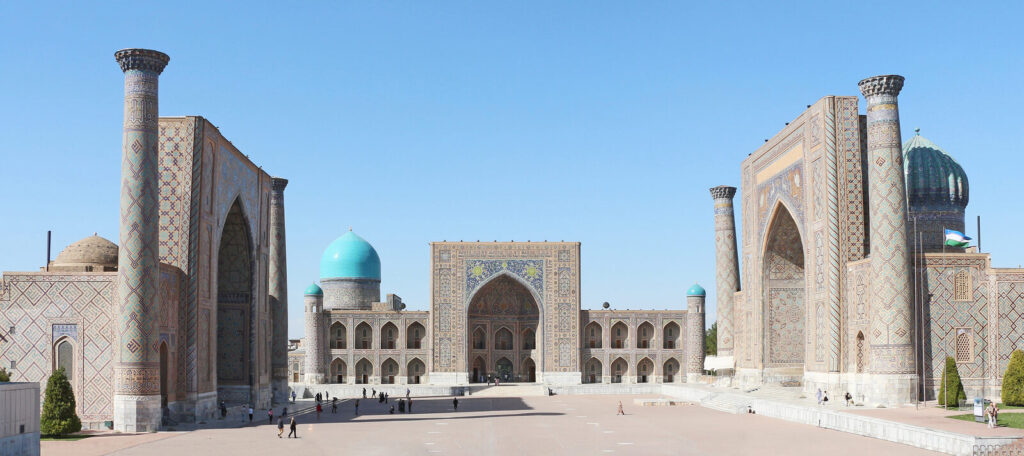
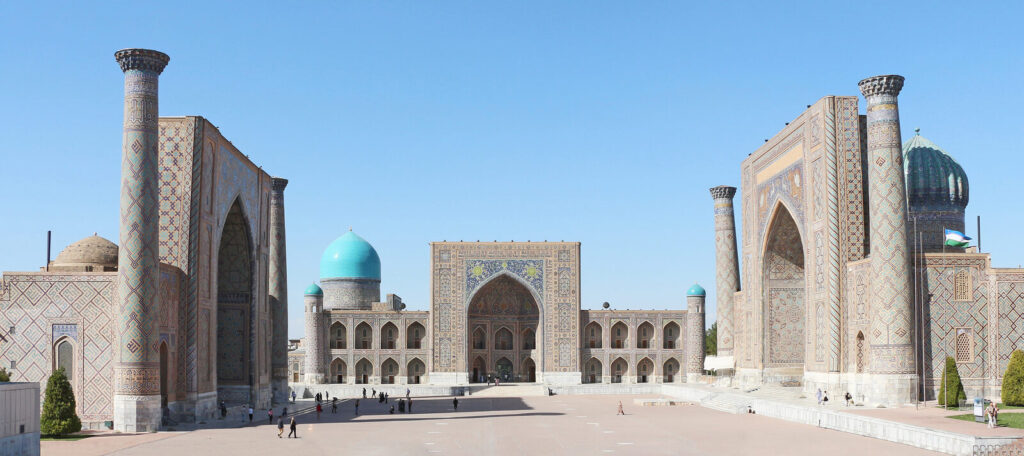
Samarkand is the image clients already have in their heads. The Registan — three madrasahs facing a common square, tiled in cobalt and gold — is one of the great built spaces on earth and the photograph that sells the tour. Nearby, Gur-e-Amir is Timur’s mausoleum, compact and intensely decorated inside; Shah-i-Zinda is an avenue of tombs whose tilework rewards a slow walk. We schedule the Registan for early morning or late afternoon, for the light and to stay ahead of the largest crowds.
Bukhara — the living medieval city
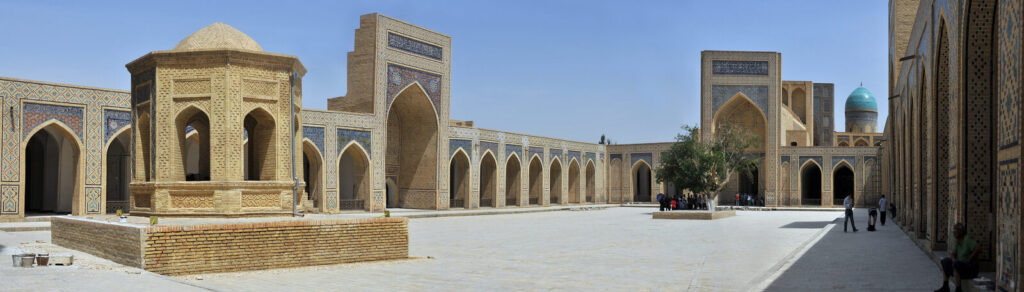
Where Samarkand is monumental, Bukhara is intimate and walkable. The Po-i-Kalyan complex — the great minaret, the mosque and the madrasah facing it — is the centrepiece. Lyabi-Hauz is a shaded pool square ringed by old buildings and tea houses, a natural spot for a group lunch or a rest hour. And the domed trading bazaars (the old taki) still cover the streets where caravans once changed money and sold silk and carpets; they’re now full of artisans, which makes for an easy, low-pressure shopping stop that clients enjoy.
Khiva — the walled city
Khiva is the most concentrated of the four. Itchan Kala, the walled inner town, is effectively an open-air museum you can cross on foot in an afternoon — minarets, madrasahs and a former khan’s palace packed inside the ramparts. It is at its best in early morning or at golden hour, when the mud-brick walls glow and the day groups have thinned out. Because Khiva is small and self-contained, it makes a satisfying finale to the route.
The classic Silk Road route — 8 days
The natural west-to-east (or east-to-west) line runs Tashkent → Samarkand → Bukhara → Khiva. A comfortable group version over 8 days:
- Day 1–2 — Tashkent. Arrive in the capital; metro, bazaars and museums while the group adjusts.
- Day 3–4 — Samarkand. The high-speed Afrosiyob train down to the Registan, Gur-e-Amir and Shah-i-Zinda.
- Day 5–6 — Bukhara. A living medieval city — the Po-i-Kalyan complex, Lyabi-Hauz and the old trading domes.
- Day 7 — Khiva. The walled inner city of Itchan Kala, best at golden hour. (For tighter schedules, some groups fly Bukhara–Urgench or end in Bukhara.)
- Day 8 — Departure from Urgench or back via Tashkent.
A longer 10-day itinerary for deeper groups
When clients want the route to breathe — special-interest groups, photography tours, repeat travellers, or anyone who balks at single-night stops — we extend to 9–10 days. The extra nights buy time rather than distance, which is exactly what most groups want.
- Day 1–2 — Tashkent. Arrival, metro and Chorsu bazaar, plus the applied-arts and history museums; an evening to recover from long-haul flights.
- Day 3–5 — Samarkand. Two full days instead of one: the Registan in two different lights, Gur-e-Amir, Shah-i-Zinda, the Bibi-Khanym mosque, the Ulugh Beg observatory, and an afternoon for a paper or ceramics workshop in the surrounding villages.
- Day 6–8 — Bukhara. Po-i-Kalyan, Lyabi-Hauz, the Ark fortress, the Chor Minor and the trading domes, with a half-day kept free for the bazaars and a tea-house lunch at an unhurried pace.
- Day 9 — Khiva. Internal flight or the desert leg to Itchan Kala, with sunset inside the walls.
- Day 10 — Departure from Urgench, or a return to Tashkent for international connections.
The 10-day version is also the easier one to combine with a neighbouring country, because you finish near the western border rather than racing back. Groups extending across the region often pair it with our Kazakhstan DMC programme for an Almaty add-on.
Why the train changes everything
The Afrosiyob high-speed service links Tashkent, Samarkand and Bukhara in a fraction of the old road time, in air-conditioned comfort. Tashkent to Samarkand runs in roughly a couple of hours; Samarkand on to Bukhara adds another stretch in the same seat. For a group, that means no long coach transfers between the three headline cities, no driver fatigue, and arrivals fresh enough to start sightseeing the same day. We book group seats early because the service is popular and capacity is limited — getting this right is the single biggest factor in a smooth, low-fatigue itinerary, and it is the part of the plan we lock first.
The exception is the western leg. Bukhara to Khiva is a long drive across open desert with little to see — manageable, but a tiring full day on the road. For most groups we add an internal flight (Bukhara or Tashkent to Urgench, the airport for Khiva) to convert that day back into sightseeing. On the longer itinerary some operators keep the desert drive as a deliberate “feel the distance” experience; on the tight 8-day version we almost always fly it.
Indicative costs by hotel tier
Uzbekistan remains good value, and the spread between tiers is driven mostly by hotels and the choice of train class versus internal flights. The figures below are indicative per-person, per-day ranges in USD for a group on a twin-share basis, including accommodation, transport, guiding and most meals — they are planning ballparks, not quotes, and they move with group size, season and fuel and air pricing.
| Hotel tier | Indicative USD / person / day |
|---|---|
| Comfortable 3-star / family-run guesthouses | $120 – $180 |
| 4-star, plus boutique and heritage hotels inside the old cities | $180 – $260 |
| Premium 5-star and the best restored caravanserai-style properties | $260 – $400+ |
The mid tier is where most groups land, because the boutique and heritage hotels inside the walled old cities of Bukhara and Khiva — converted madrasahs, merchant houses and courtyard properties within a short walk of the monuments — are part of the experience clients remember, and they don’t carry true five-star prices. Internal flights, train upgrades and any extensions sit on top of these ranges.
When to go
Spring (April–May) and autumn (September–October) are the prime windows: warm days, cool evenings and the clear light that makes the tilework photograph well. Summer (June–August) brings fierce heat in the desert cities — Bukhara and Khiva in particular become hard work for older groups, and any midday sightseeing has to be rescheduled to early morning and late afternoon. Winter is quiet and cold but does happen for culture-focused groups who want the monuments to themselves; we plan it with realistic daylight hours and indoor alternatives. For most agents, the two shoulder seasons are where the route sells best, so we recommend booking train seats and heritage hotels early, as those windows fill.
Practical tips for group leaders
A few things make a real difference to how a Silk Road group runs:
- Visas. Many nationalities are visa-free for 30 days and most others use the online e-visa, but mixed-passport groups need checking person by person. We confirm the rule for each passport before we finalise — don’t assume one nationality’s status applies to the whole coach.
- Money and connectivity. Cash still matters outside the bigger hotels and restaurants; cards are increasingly accepted in cities but not everywhere. A local SIM or eSIM is cheap and keeps a group leader reachable; we brief travellers on what to carry and where to change money safely.
- Meal planning. Distances between sights are short but days are full, so we set meal stops deliberately — a tea-house lunch at Lyabi-Hauz, a courtyard dinner in a heritage hotel — and confirm dietary needs in advance. Uzbek cuisine is meat- and bread-heavy, so vegetarian and other requirements are worth flagging early.
- Pacing. The tilework and the heat both reward an early start and a midday break. We build the schedule around the light, not the clock.
- Guiding. The history here is dense and easy to muddle; a strong English-speaking guide who can make Timur, the trading routes and the madrasahs land for a lay audience is what turns a good tour into one clients recommend.
On-the-ground support
Our Uzbekistan DMC team handles train and internal-flight bookings, boutique and heritage hotels inside the old cities, expert guides who bring the history alive, and the meal arrangements that keep a group fed well between sights. We sequence the trains and the Urgench flight so the route flows in the right order, and we hold group seats early in the prime seasons. Travellers extending across Central Asia often pair this with our Kazakhstan DMC programme.
Frequently asked questions
Do you need a visa for Uzbekistan?
Many nationalities are visa-free for 30 days; most others use a simple online e-visa. We confirm the current rule for every passport in your group, which matters most for mixed-nationality coaches.
How many days do you need for the Silk Road cities?
Seven to eight days covers Tashkent, Samarkand, Bukhara and Khiva at a comfortable pace. Five days works if you focus on Samarkand and Bukhara, and nine to ten days lets a group slow down with two full days in Samarkand and time for workshops.
Is the train better than driving?
For the Tashkent–Samarkand–Bukhara corridor, yes — the Afrosiyob is faster and far more comfortable than the coach, and it keeps groups fresh. We reserve group seats well in advance because capacity is limited.
How do groups get from Bukhara to Khiva?
It’s a long desert drive with little to see, so for most groups we add an internal flight to Urgench (the airport for Khiva) and convert that day back into sightseeing. Longer itineraries can keep the drive if the group prefers to feel the distance.
What’s the best time of year for a group tour?
April–May and September–October are ideal — warm, clear and comfortable. Summer is hot in the desert cities, so we shift sightseeing to early and late in the day. We recommend booking train seats and heritage hotels early for the shoulder seasons.
What do the per-person costs include?
Our planning ranges cover accommodation, ground transport, the Afrosiyob train, guiding and most meals on a twin-share basis. Internal flights, train upgrades and any extensions sit on top. Send us your dates, pax and preferred hotel tier and we’ll turn it into a firm quote.
Planning a Silk Road group tour? We handle trains, internal flights, heritage hotels, guides and meals end to end. Explore our Uzbekistan DMC services or request a group quote with your dates and pax.
Photos: the Registan, Samarkand by Bernard Gagnon (CC0); Po-i-Kalyan, Bukhara by LBM1948 (CC BY-SA 4.0), via Wikimedia Commons.

Travel DMC Group
Travel DMC Group is a B2B destination management company handling ground services — hotels, transfers, guided tours, MICE and group logistics — across Asia, the Middle East and the Caucasus. These guides are written by our in-house operations and product team from first-hand experience running group departures.